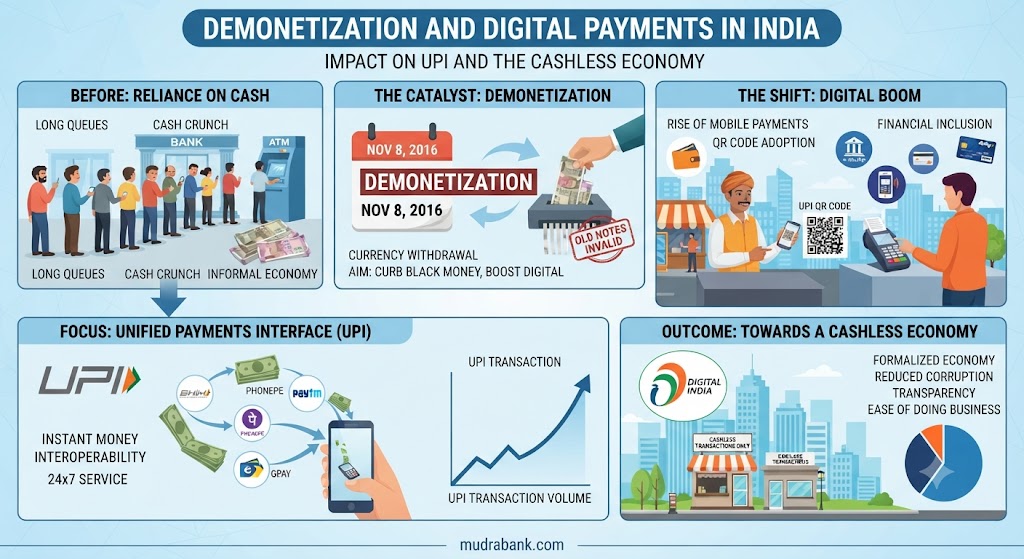
Demonetization and digital payments in India: The currency withdrawal announced on 8 November 2016 brought cash availability and alternative payment methods into sharp public focus. It encouraged many consumers and businesses to explore electronic payments, while the longer-term expansion of digital transactions was also shaped by UPI, smartphones, QR codes, bank-account access, merchant acceptance and continued investment in payment infrastructure.
Quick answer: Demonetization was an important moment in India’s move towards digital payments, but it was not the sole cause of the country’s digital-payment growth. UPI and other payment systems subsequently made it easier for people and businesses to transfer money electronically, pay merchants and manage everyday transactions.

What Was Demonetization in India?
On 8 November 2016, the Government of India announced the withdrawal of the then-existing ₹500 and ₹1,000 banknotes of the Mahatma Gandhi series as legal tender, subject to the announced rules and exceptions. The decision affected cash-dependent households, traders, small businesses and other parts of the economy. People had to exchange or deposit eligible notes through the banking system and adjust to a period of disruption in cash-based transactions.
Because cash was temporarily harder to access for many people, digital payment options received greater attention. Consumers and merchants considered bank transfers, cards, mobile wallets and other electronic methods. However, the effects varied by location, internet access, device availability, digital literacy and the type of business. The experience was not the same for every household or enterprise.
How Did Demonetization Influence Digital Payments?
Demonetization increased public awareness of alternatives to cash and encouraged some people to try digital transactions. It is more accurate to describe it as one influence on payment behaviour than to attribute the entire rise of digital payments to a single policy decision.
1. Greater awareness of electronic transactions
During the period of cash shortages, consumers looked for ways to pay without relying entirely on physical currency. Businesses also explored electronic payments to serve customers when cash was unavailable. This brought more attention to mobile banking, debit cards, online fund transfers and digital wallets.
2. Wider use of mobile payment applications
Mobile applications made it possible for eligible users to initiate payments from their phones. The BHIM app, launched in December 2016, helped raise awareness of UPI-based payments. Over time, banks and third-party payment applications expanded their features and made digital transactions part of everyday shopping, bill payments and person-to-person transfers.
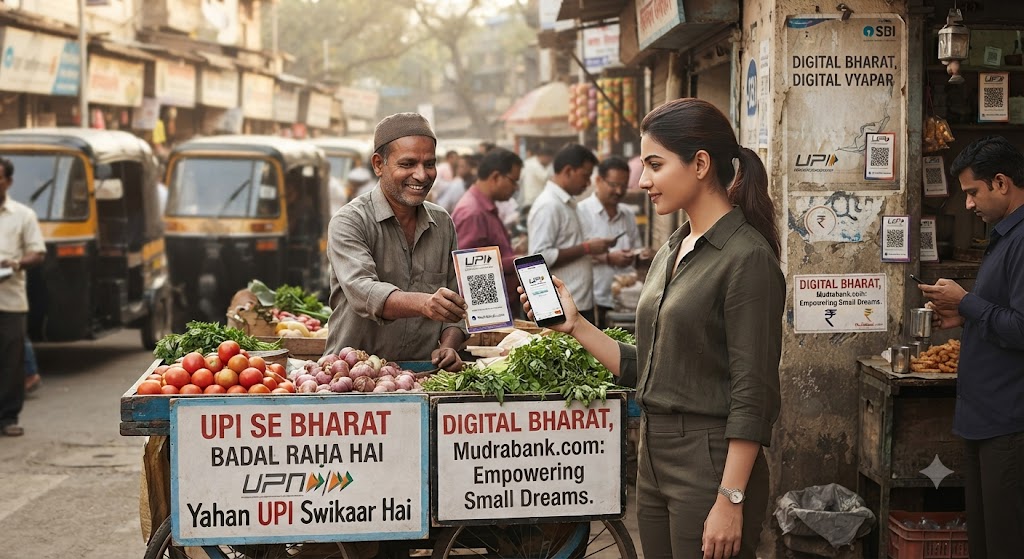
3. Digital payments for small shops and local businesses
Small retailers, service providers and other merchants increasingly had reasons to consider digital acceptance methods. QR-code payments became a practical option for many businesses because customers could scan a code and pay through a compatible application. The suitability of a payment method still depends on connectivity, customer preferences, settlement arrangements and any applicable charges.
4. More attention to formal banking channels
Digital transactions depend on access to suitable accounts, payment services and supporting infrastructure. Bank-account access, mobile connectivity, payment-system development and consumer familiarity all contribute to the ability to use digital payments. Financial inclusion therefore involves more than simply replacing cash: people also need accessible services, understandable information and ways to resolve failed or disputed transactions.
UPI and the Transformation of Digital Payments in India
The Unified Payments Interface (UPI), developed by the National Payments Corporation of India (NPCI), became a major part of India’s digital-payment ecosystem. It allows users of participating banks and compatible applications to make supported bank-to-bank payments. Depending on the application and transaction type, users may pay a merchant by QR code or transfer money to another person without exchanging cash.
UPI was introduced in 2016, around the same period as demonetization. Its later growth reflects a combination of factors, including wider smartphone adoption, easier app experiences, QR-code acceptance, bank participation, merchant use and the development of payment infrastructure. The timing is important, but timing alone does not establish that demonetization caused every subsequent increase in UPI transactions.
Recent UPI growth: official figures
In 2026, the Ministry of Finance reported that UPI processed approximately 24,162 crore transactions with a value of about ₹314 lakh crore in financial year 2025–26. These figures illustrate the scale that UPI has reached. They describe UPI activity, not a measurement of the isolated effect of demonetization.
For current monthly statistics, readers should consult the official NPCI UPI product statistics. For broader government reporting, see the Ministry of Finance’s report on UPI and digital payments.
Benefits of Digital Payments for Consumers and Businesses
Digital payments can make everyday transactions more convenient, but their benefits depend on the payment method, the user’s circumstances and the reliability of the service.
- Convenience: Compatible applications can enable payments without carrying exact cash or visiting a branch for every transaction.
- Faster transfers: Supported payment systems can transfer funds electronically, subject to system availability and transaction rules.
- Payment records: Transaction histories can help individuals and businesses reconcile payments and maintain records.
- Merchant choice: Digital acceptance gives customers another way to pay and may help businesses serve a wider range of payment preferences.
- Access to digital services: Familiarity with electronic payments can support the use of online banking, bill payment and other digital financial services.
- Less dependence on physical cash: Electronic methods provide an alternative when cash handling is inconvenient, although cash remains important for many people and transactions.
Challenges and Risks of a Cashless Economy
Digital payments are useful, but they do not remove every financial or operational problem. A balanced view should consider the challenges alongside the benefits.
- Internet and device access: Some users may have limited connectivity, suitable devices or digital skills.
- Failed or delayed transactions: Technical issues can lead to pending payments or uncertainty about whether a transaction succeeded.
- Fraud and social engineering: Scammers may impersonate banks, payment providers or government officials to obtain confidential information.
- Privacy and security: Users should protect their devices, PINs and authentication details and review transactions regularly.
- Dependence on infrastructure: Power, network or payment-system interruptions may affect digital transactions.
- Business costs and reconciliation: Merchants need to understand settlement times, records, support processes and any applicable charges.
Digital-payment safety tip: Never share your UPI PIN, OTP or banking password with another person. A UPI PIN is generally used to authorise a payment, not to receive money. Verify the recipient and amount before approving a transaction, and use your bank’s official channel to report suspicious activity.
Demonetization, Small Businesses and Access to Credit
Small businesses need working capital to buy stock, pay suppliers, purchase equipment and manage operating expenses. Digital payment records may help a business understand its sales and maintain better accounts, but they do not automatically qualify the business for a loan or guarantee approval.
Eligible micro-enterprises may explore the business loan information guide and the Mudra loan schemes guide on this website. For official scheme details, consult the Department of Financial Services’ PMMY page. Eligibility, interest rates, documents and sanction decisions depend on the participating lending institution and the applicant’s circumstances.
Is India Becoming a Cashless Economy?
India has become a major digital-payment market, but “cashless economy” is best understood as a direction rather than a claim that cash has disappeared. People continue to use cash alongside cards, bank transfers, UPI and other payment methods. The mix varies by transaction, location, business type and user preference.
The long-term development of digital payments depends on reliable infrastructure, secure systems, consumer trust, merchant participation, accessible grievance mechanisms and financial literacy. Policy decisions, innovation by payment providers and changing user habits all play a role. No single event fully explains this transformation.
Frequently Asked Questions
Did demonetization increase digital payments in India?
Demonetization brought digital payment options into greater public focus and encouraged some consumers and businesses to use alternatives to cash. The longer-term growth of digital payments also reflects UPI, mobile internet, QR codes, banking access and other developments.
What is the role of UPI in India’s digital economy?
UPI enables supported instant bank-to-bank payments through participating banks and compatible applications. It is widely used for person-to-person transfers and merchant payments, including QR-code transactions.
Is India a completely cashless economy?
No. Digital payments are widely used, but cash remains part of India’s economy. People choose payment methods according to access, convenience, transaction needs and personal preference.
Are digital payments always safe?
No payment method is entirely risk-free. Use official applications, protect your PIN and OTP, verify recipient details and contact your bank promptly if you notice a suspicious or incorrect transaction.
Where can I check current UPI transaction statistics?
Check the official NPCI UPI statistics page for published monthly data. Government announcements and reports may also provide annual figures and wider context.
Official Sources and Further Reading
- NPCI — UPI Product Statistics
- Ministry of Finance — UPI and Digital Payments
- Reserve Bank of India
- National Payments Corporation of India
Editorial note: This article is intended for general information and discussion. It does not claim that demonetization alone caused the growth of digital payments, and it should not be treated as financial, legal or investment advice. Statistics and policies can change; readers should consult official sources for current information.
Content Overview