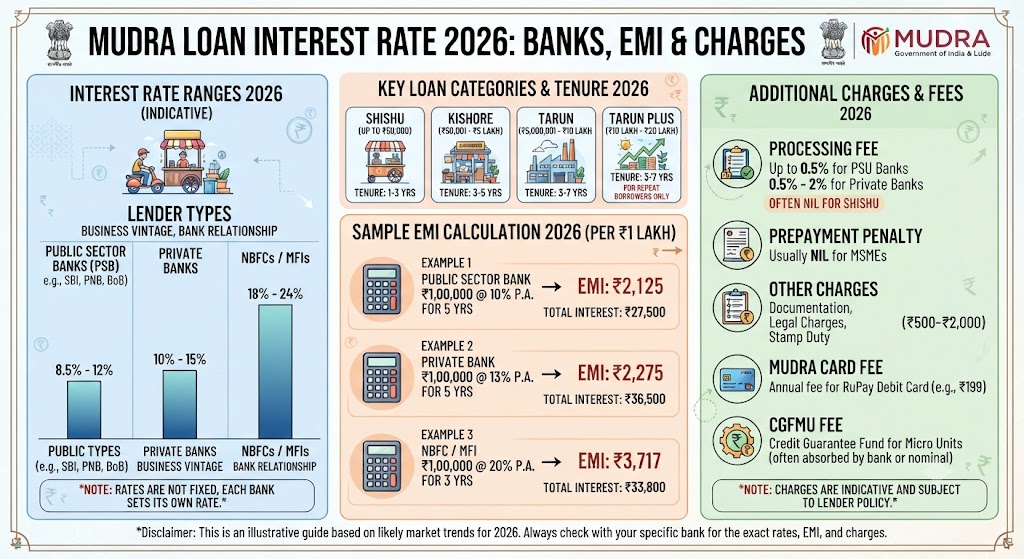
Mudra Loan Interest Rate 2026: Bank Rates, EMI and Charges
Looking for the latest Mudra loan interest rate in India? The interest rate on a loan under the Pradhan Mantri MUDRA Yojana (PMMY) depends on the lending institution, loan product, business profile and applicable lending terms. There is no single interest rate that applies to every borrower or every bank.
This guide explains how Mudra loan interest rates work, the Shishu, Kishor, Tarun and Tarun Plus categories, how to compare lender offers, how to estimate your monthly EMI and which charges to check before accepting a loan.
Important: MudraBank.com is an independent information website. It is not the official website of the Government of India, MUDRA or any bank. Interest rates and loan terms can change. Confirm the current rate, fees and eligibility directly with your chosen lender before applying.
What Is the Mudra Loan Interest Rate?
Mudra loans are provided by eligible lending institutions under the Pradhan Mantri MUDRA Yojana. Depending on the institution, these lenders can include public sector banks, private sector banks, regional rural banks, small finance banks, non-banking financial companies and microfinance institutions.
The interest rate is determined by the lending institution under its applicable lending policy and regulatory requirements. It can vary between lenders and loan products. Your business activity, repayment capacity, credit history, requested amount, repayment period and the type of facility may influence the offer you receive.
There is therefore no reliable single percentage that can be quoted as the current Mudra loan interest rate for every applicant. A rate published for one bank or product should not automatically be treated as applicable to another bank or borrower.
For scheme information, visit the Government of India’s official PMMY information page.
Mudra Loan Categories and Maximum Amounts
PMMY classifies eligible loans into four categories according to the funding requirement and the stage of the business. These categories define loan amounts, not fixed interest rates.
| Loan category | Loan amount | General purpose |
|---|---|---|
| Shishu | Up to ₹50,000 | Small or early-stage business requirements |
| Kishor | Above ₹50,000 and up to ₹5 lakh | Business development, stock, equipment or working capital |
| Tarun | Above ₹5 lakh and up to ₹10 lakh | Expansion and larger eligible business requirements |
| Tarun Plus | Above ₹10 lakh and up to ₹20 lakh | Eligible entrepreneurs who have successfully repaid a previous Tarun-category loan |
Tarun Plus became applicable from 24 October 2024 for eligible borrowers who have successfully repaid a previous Tarun loan. Eligibility and approval remain subject to the scheme conditions and the lender’s assessment. Check the current official notification for complete details.

Mudra Loan Interest Rate by Bank: How to Compare Offers
People often search for the lowest Mudra loan interest rate by bank. However, a rate advertised for a particular product may not apply to every applicant or every category. Rates, fees, repayment terms and eligibility criteria can differ across institutions and change over time.
Instead of relying on an old comparison table, request a current written quotation or loan offer from each eligible lender you are considering. Compare the terms for the same loan amount and a similar repayment period.
What to compare before choosing a lender
- Annual interest rate: Check the actual rate offered for your loan, not only a starting rate shown in an advertisement.
- Fixed or floating rate: Confirm how the rate is structured and whether it can change during the loan period.
- Repayment period: Compare the tenure and the number of instalments offered.
- Processing and other fees: Ask about processing charges and any applicable documentation, service or other fees.
- Repayment method: Confirm the instalment schedule, repayment date and available payment methods.
- Late-payment consequences: Understand applicable penal charges and the consequences of missed instalments.
- Total repayment: Compare the overall amount payable, rather than choosing only by the advertised interest rate.
For example, a loan with a slightly lower advertised rate may not be the least expensive option if its applicable fees or repayment conditions differ. Request a complete cost breakdown before making your decision.
Does SBI Offer the Lowest Mudra Loan Interest Rate?
There is no basis for assuming that State Bank of India (SBI), or any other bank, always offers the lowest interest rate for every Mudra loan. The rate applicable to you depends on the current product terms and the bank’s assessment of your application.
To compare SBI with other eligible lenders, obtain current written offers for the same loan amount and tenure. Check the interest rate, applicable fees, repayment schedule and total cost. Confirm all details directly with the bank before accepting an offer.
Are Mudra Loans Interest-Free?
You should not assume that a Mudra loan is interest-free. PMMY is a credit scheme, and the interest and other applicable terms depend on the lending institution and the specific loan product. Any claim of a zero-interest offer should be verified directly with the lender through official written terms before you apply.
Be cautious of advertisements that promise guaranteed approval, zero interest or special government benefits without providing verifiable official conditions. Do not pay an intermediary who claims they can guarantee a loan sanction.
How Is the Mudra Loan EMI Calculated?
Your monthly instalment, commonly called EMI, depends on the loan principal, the interest rate and the repayment period. You can use the standard reducing-balance EMI formula to estimate the instalment for a term loan.
EMI formula: EMI = P × r × (1 + r)n ÷ [(1 + r)n − 1]
- P: Loan principal amount.
- r: Monthly interest rate expressed as a decimal. For a nominal annual rate, divide the annual percentage rate by 12 and then by 100.
- n: Total number of monthly instalments.
Illustrative example: If you borrow ₹1,00,000 at an assumed nominal annual interest rate of 12% for 24 months, the estimated EMI is approximately ₹4,707. This is a mathematical illustration, not a current offer from any bank. Actual instalments and total repayment may differ because of the lender’s terms, fees, rate structure and repayment method.
For a practical estimate, use the actual rate and tenure quoted by your lender. Also check whether the quoted rate is applied on a reducing balance or another basis, and whether any additional charges apply.
What Factors Affect the Mudra Loan Interest Rate?
Although the final offer is determined by the lender, the following factors may influence its assessment:
- Business cash flow: Sales, operating expenses and the ability to repay the proposed instalments.
- Credit and repayment history: Existing obligations, repayment behaviour and information available to the lender.
- Loan amount and tenure: The requested facility and repayment structure.
- Business activity: The nature of the enterprise and the purpose for which the funds are required.
- Banking relationship and records: Account activity and supporting financial documents, where relevant to the lender’s assessment.
- Lender policy: The institution’s applicable product terms, pricing rules and eligibility requirements.
Documents to Prepare for a Mudra Loan Application
The documents required vary by lender, business type and loan category. Depending on your application, you may be asked for:
- Identity and address proof.
- Business registration or business activity details, where applicable.
- Bank statements and relevant financial records.
- Details of the proposed business activity and use of funds.
- Business plan, cost estimates or project report, where requested.
- Existing loan details and repayment information, where applicable.
- Photographs, declarations or additional forms specified by the lender.
This is a general checklist, not a universal list of mandatory documents. Ask your selected lender for its current requirements. Submit personal and financial information only through verified official channels.
How to Apply for a Mudra Loan
- Identify an eligible bank or financial institution that offers the relevant PMMY loan product.
- Review the lender’s current eligibility criteria and document checklist.
- Estimate your funding requirement and prepare a realistic business plan or explanation of how the funds will be used.
- Ask the lender for the applicable interest rate, repayment tenure, fees and other terms.
- Submit the application through the official channel specified by the lender.
- Read the sanction letter and Key Facts Statement (KFS), where applicable, before accepting the offer.
- Keep a copy of your application, acknowledgement, sanction terms and repayment schedule.
You can read the Government of India’s PMMY scheme details before approaching a lender. The final decision on sanction, interest rate and loan terms rests with the lending institution in accordance with the applicable rules.
Key Facts Statement and Loan Charges
Before signing a loan agreement, carefully review the lender’s written disclosures. The Key Facts Statement (KFS), where applicable under RBI requirements, is intended to help borrowers understand important loan terms, including the annual percentage rate (APR), repayment schedule and applicable charges.
Ask the lender to explain any term you do not understand. Do not rely solely on verbal assurances, social media advertisements or an agent’s promise. Keep the official documents for your records.
Beware of Mudra Loan Fraud
Be alert to fake websites, messages and agents claiming to provide guaranteed Mudra loan approval. A government scheme does not mean every website or person advertising a loan is authorised to process applications.
- Verify the lender and application website independently.
- Do not pay a person who promises guaranteed sanction or preferential treatment.
- Pay a fee only if it is stated in the lender’s official terms and use the authorised payment method.
- Never disclose OTPs, PINs, passwords or banking credentials to an agent.
- Do not treat an approval message or certificate sent through an unverified channel as genuine.
- Report suspected fraud to the relevant lender and appropriate authorities.
Frequently Asked Questions About Mudra Loan Interest Rates
1. What is the Mudra loan interest rate in 2026?
There is no single interest rate for every Mudra loan in 2026. The applicable rate depends on the lending institution, loan product and borrower assessment. Contact the lender for its current written offer.
2. Is the Mudra loan interest rate the same at every bank?
No. Rates and terms can differ across eligible lenders and products. Compare current offers for the same loan amount and tenure before choosing a lender.
3. Which bank offers the lowest Mudra loan interest rate?
There is no bank that can be guaranteed to have the lowest rate for every applicant at all times. Obtain current quotations from eligible lenders and compare the rate, fees, repayment terms and total cost.
4. Are Shishu Mudra loans interest-free?
Do not assume that a Shishu loan is interest-free. Check the current terms of the lender offering the loan and ask for written confirmation of the interest rate and applicable charges.
5. What is the maximum loan amount under PMMY?
PMMY includes Shishu loans up to ₹50,000, Kishor loans above ₹50,000 and up to ₹5 lakh, Tarun loans above ₹5 lakh and up to ₹10 lakh, and Tarun Plus loans above ₹10 lakh and up to ₹20 lakh for eligible borrowers who have successfully repaid a previous Tarun loan.
6. How can I calculate my Mudra loan EMI?
EMI depends on the principal, applicable interest rate and number of monthly instalments. Use the standard reducing-balance EMI formula or a reliable calculator, then confirm the final repayment schedule with the lender.
7. Does a Mudra loan require collateral?
PMMY is designed to provide eligible credit without requiring collateral. However, applicants must still meet the lender’s requirements, and the actual facility and terms must be confirmed with the institution processing the application.
8. What should I check before accepting a Mudra loan?
Check the interest rate, APR where applicable, loan tenure, EMI, fees, repayment schedule, late-payment consequences and all conditions in the sanction letter and other loan documents. Ask the lender to explain anything unclear before signing.
Conclusion: Compare the Total Cost, Not Just the Interest Rate
The right Mudra loan depends on your business requirement, repayment capacity and the terms offered by the lender. Rather than relying on a general online rate or a promise of the cheapest loan, compare current written offers and understand the complete cost before borrowing.
Disclaimer: This article is for general educational purposes and is not a loan offer, financial advice or a guarantee of approval. Scheme rules, lender policies, rates and fees may change. Verify current information with the official scheme resources and the lending institution before taking a financial decision.
Content Overview